
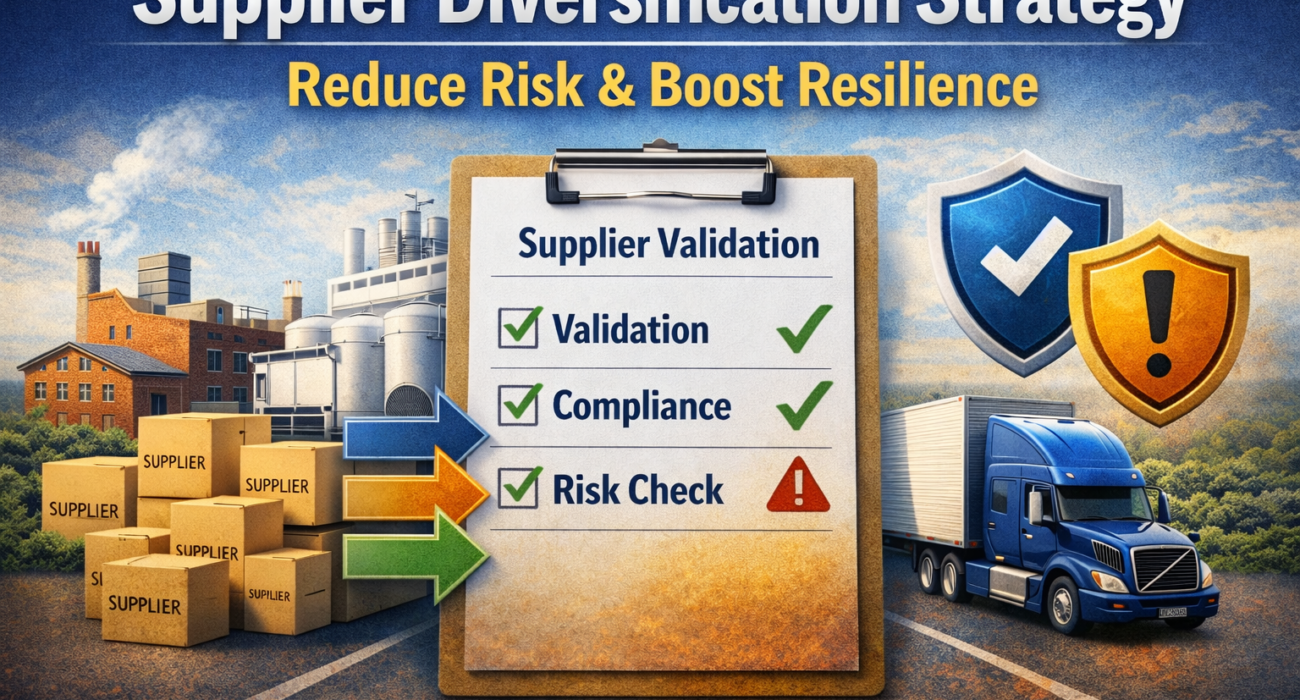

For years, supplier diversification was treated as a “nice to have.”
Today, it is a strategic necessity.
Importers, brands, and manufacturers operating in regulated markets have learned — often the hard way — that relying on a limited number of suppliers exposes businesses to operational, regulatory, and geopolitical risks that can no longer be ignored.
Yet diversifying suppliers is not a quick fix. It requires time, effort, and expertise.
Why supplier diversification is difficult in practice
On paper, adding alternative suppliers sounds straightforward.
In reality, it involves far more than identifying new origins.
Effective diversification requires:
- Validation of processing standards (pasteurization, sterilization)
- Verification of food safety systems
- Alignment with EU and North American regulations
- Consistency in quality, specifications, and documentation
- Confidence in a supplier’s ability to perform over time
Each new supplier represents a new risk profile — unless properly qualified.
How COVID-19 reshaped sourcing strategies
The COVID-19 pandemic was a turning point.
Suddenly, supply chains that had been considered “stable” were disrupted by:
- Factory shutdowns
- Port congestion
- Logistics bottlenecks
- Labor shortages
Many buyers discovered that single-source or region-dependent strategies left them exposed.
Since then, diversification is no longer driven only by cost or availability — it is driven by resilience.
Importers now ask:
- What happens if one supplier stops production?
- How quickly can we switch origins?
- Are alternative suppliers already validated?
A changing trade landscape: tariffs and uncertainty
Beyond pandemics, global trade dynamics continue to evolve.
- Tariffs are shifting
- Trade agreements are being renegotiated
- Geopolitical tensions impact sourcing decisions
For importers serving regulated markets, these changes add another layer of complexity.
Diversification must now consider regulatory access, duty exposure, and long-term viability, not just price.
Why diversification takes time — and where value is created
Diversifying suppliers responsibly is not a sourcing sprint.
It is a structured process that includes:
- On-site supplier visits
- Processing and compliance audits
- Documentation verification
- Operational alignment
This is where many buyers face a bottleneck:
they lack the time, local access, or expertise to validate suppliers properly.
How Jasmi Impex accelerates diversification
At Jasmi Impex, supplier diversification is approached as a risk-management exercise, not a product search.
Our value lies in:
- A global, pre-qualified supplier network
- Regular on-site visits and assessments
- Deep understanding of pasteurized and sterilized processing
- Experience navigating EU and North American requirements
- First-hand knowledge of supplier capabilities and limitations
Because suppliers are already vetted, diversification becomes faster, safer, and more strategic.

From reactive sourcing to informed decisions
Diversification should not start during a crisis.
It should be planned before disruptions occur.
By working with experienced sourcing partners, importers can:
- Reduce dependency on single suppliers
- Protect brand integrity
- Maintain continuity across markets
- Make informed decisions under pressure
Final thought
In today’s environment, diversification is no longer about “finding more suppliers.”
It is about building resilient, compliant supply chains that can withstand uncertainty.
That requires time — unless you work with partners who have already done the work.